

Stories > Remarkable results in the most challenging places
“And now these three remain: faith, hope and love. But the greatest of these is love.” – 1 Corinthians 13:13
Like almost a million other Rohingya refugees, her family fled violence and persecution in Myanmar in search of safety.
Harisa lives with cerebral palsy. When her parents carried her to safety as a small child, she could not walk, talk, or even make eye contact. Her world was limited to lying on the floor, unable to communicate, or interact with those around her.
But her parents never gave up hope.
Through a cbm-supported programme for Rohingya refugees with disabilities, Harisa began receiving specialist rehabilitation and speech therapy.
“It was you,” her mother Noor said. “Your service and dedication has brought so much improvement to my daughter.”
Harisa’s speech therapist carefully worked to relax the rigid muscles affected by her cerebral palsy. Therapy included oral motor exercises for her lips, jaw, tongue, and cheeks, along with swallowing exercises, and posture support to help her eat more safely and comfortably.
But the support went far beyond physical therapy.
Having lived in isolation for so long, Harisa had not developed many of the social and communication skills most children learn naturally through play and interaction. Her therapist helped her learn to make eye contact, relate to others, pay attention, and communicate with the people around her.
Over time, remarkable changes began to happen.
Harisa’s jaw and tongue became more relaxed. She started developing communication skills and greater social connection. Her parents faithfully practised the exercises with her every day, helping reinforce the progress she was making.
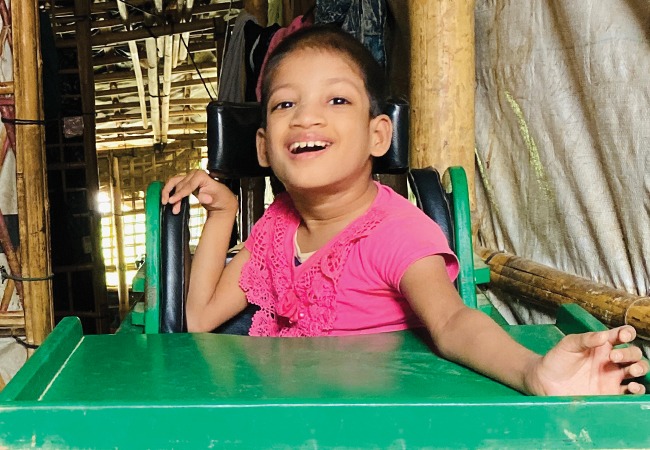
She also received practical support, including assistive devices and a supportive chair that allowed her to sit upright after years spent lying on the floor. Physiotherapy and home modifications further improved her mobility and independence.
“Harisa has started developing understanding and socialisation,” her speech therapist explained. “She is grateful for her growing communication skills. So are her parents.”
Today, Harisa is able to communicate, interact with others, and express joy in ways that once seemed impossible. While cerebral palsy remains part of her life, she now has greater connection, confidence, and opportunity for the future.
Life in the refugee camps remains incredibly difficult, especially for people living with disabilities. But through inclusive rehabilitation and compassionate care, children like Harisa are receiving support that helps them participate more fully in family and community life.
Harisa’s story is a powerful reminder that even in the most challenging circumstances, access to therapy, rehabilitation, and disability-inclusive support can help restore dignity, connection, and hope.
Your gift will help support disability therapy, including physiotherapy, occupational therapy, speech language therapy, and hearing and vision services for children like Harisa – and adults too.
It will help provide assistive technologies, including mobility devices like Harisa’s, or hearing aids and glasses.
Thank you for your kindness!